

Like Dickens’ London orbit, you weigh a town by what it gives you for what it costs. In Slough, you typically pay less than nearby commuter favourites yet still get 5–7% rental yields, fast Elizabeth Line access into central London, and a job base tied to Heathrow and the M4. But value isn’t just price-per-square-foot; it’s liveability, risk, and upside—so where does Slough actually score highest, and where does it fall short?
Key Takeaways
- Slough offers London access via the Elizabeth line in roughly 30–45 minutes, plus fast M4/M25 links to Heathrow and major hubs.
- Homes typically cost less than nearby Windsor, Maidenhead, and Beaconsfield, delivering more space per pound than many South East commuter towns.
- Rental yields are comparatively strong—about 5–7% for flats and 4–6% for houses—supported by steady demand from Trading Estate and Heathrow jobs.
- Value depends heavily on neighborhood: Chalvey and parts of Cippenham suit first-time buyers, while Cippenham and Wexham better fit families.
- Living costs can be competitive, with good local amenities and often lower council tax than nearby districts, but commute reliability and safety vary by area.
Is Slough Good Value? The 5-Part Scorecard

Where does Slough actually sit on the value spectrum in the South East? Use this 5-part scorecard to judge it against regional norms without fixating on sale prices.
1) Connectivity: you’re within the London employment catchment, with fast rail links and the M4 spine.
2) Jobs base: you benefit from a large, diverse employer mix, including logistics, services, and office campuses.
3) Supply and build profile: you get more modern stock and higher-density schemes than many traditional commuter towns.
4) Amenities: you access cultural attractions like Curve and nearby Thames-side leisure, plus strong retail choice.
5) Identity and churn: local history exists, but perception and turnover can dilute community feel.
Net: practical value skews high if you prioritise access and employment.
Slough House Prices vs Nearby Commuter Towns
Although headline averages shift quarter to quarter, Slough typically prices below “classic” nearby commuter towns such as Windsor, Maidenhead, Beaconsfield, Gerrards Cross, and Marlow, while landing closer to (or slightly above) parts of Hayes, Southall, and Uxbridge—so the real comparison comes down to what you’re buying for the money.
Newer flats and higher-density estates near the station and M4 in Slough often offer more square footage per pound than in Maidenhead or Windsor.
Historical development explains the gap: Slough expanded around industry and post-war estates, while river and Chiltern towns constrained supply.
Local amenities matter too—Windsor’s leisure offer and top catchments capitalize into prices.
If you prioritize rail time and modern stock, you’ll often get more square footage per pound in Slough than in Maidenhead or Windsor.
Slough Rental Yields: What Landlords Can Expect
Price is only half the landlord equation; the other half is rent, and Slough often looks stronger on yields than pricier neighbours because purchase prices haven’t run as far ahead of achievable rents.
On typical figures, you’ll more often see gross yields around 5–7% for Slough apartments and 4–6% for family houses, versus nearer 3–5% in parts of Windsor, Maidenhead, or outer West London.
Net yield depends on your Property management costs, voids, and compliance spend. If you budget 10–15% for management and 5% for maintenance, a 6% gross yield can compress toward 4–5% net.
Your best Investment strategies focus on demand-led unit sizes, walkable amenities, and energy efficiency to protect rentability and reduce turnover risk.
How Quick Is Slough to London on the Elizabeth Line?
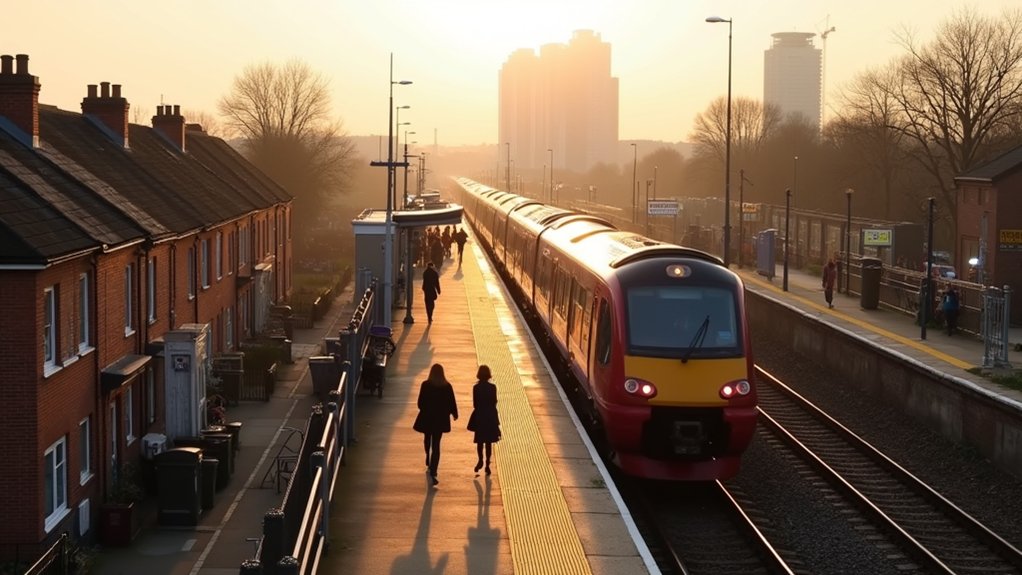
If you live in Slough, you can reach London Paddington on the Elizabeth line in roughly 20–30 minutes, depending on the service pattern and stops.
You’ll typically see tighter, more predictable timings off-peak, while peak periods can add minutes due to higher dwell times and platform congestion.
To compare Slough with other South East commuter towns fairly, you should look at median peak vs off-peak journey times and service frequency, not just the quickest advertised trip.
Elizabeth Line Journey Times
With the Elizabeth line now serving Slough directly, you can benchmark the commute against other South East hubs. Typical travel time from Slough to Paddington sits around 20 minutes, putting you in the same bracket as Maidenhead (about 20 minutes) and ahead of Reading (roughly 25–30 minutes).
If you stay on the Elizabeth line beyond Paddington, you can reach key Central London stations in competitive times: expect roughly 30–35 minutes to Bond Street, around 35–40 minutes to Tottenham Court Road, and about 40–45 minutes to Liverpool Street.
Compare that with Windsor, where you’ll usually need a change and longer end-to-end timing. For Canary Wharf, you’ll likely see around 50–60 minutes, depending on interchange needs.
Peak Vs Off-Peak Speed
Journey time benchmarks matter, but the time of day can shift what you’ll actually see on the clock. On the Elizabeth line, Slough–Paddington typically runs about 22–30 minutes, but reliability differs between peak hours and quieter periods.
In peak hours, you’re more likely to hit tighter timetables, higher dwell times at busy stations, and knock-on delays, so end-to-end trips can drift toward the upper end of that range and feel less predictable.
Off peak benefits show up as steadier platform conditions and fewer minor holds, so you more often land closer to the fastest scheduled times.
If you’re comparing South East commuter towns, that variance matters: the median time may look similar, but off-peak consistency can be the real advantage for flexible travel.
Slough Jobs and Salaries vs Thames Valley Hubs

Although Slough often gets framed as a cheaper alternative to its neighbours, its jobs market competes directly with the Thames Valley hubs on both volume and pay. You tap into local job opportunities anchored by Slough Trading Estate, one of Europe’s largest, plus Heathrow-linked logistics, data centres, and multinational back offices.
Compared with Reading’s finance and tech cluster or Maidenhead’s corporate HQ mix, Slough skews more operational but still offers graduate, specialist, and contract roles.
On salary competitiveness, Slough typically tracks the wider Thames Valley rather than “outer London” lows: professional pay sits close to Reading levels, while admin and warehousing rates can be higher due to shift patterns and demand.
If you can commute within the corridor, you widen options without sacrificing earnings potential.
Slough Cost of Living: Bills, Council Tax, Childcare
After pay, you’ll feel the difference in what you spend on household bills, and Slough’s typical utilities and broadband costs can track close to South East norms but vary by property size and supplier.
You’ll also want to compare council tax bands and annual charges against nearby authorities, because small band differences can add up across the year.
If you’ve got children, childcare is often the biggest swing factor, so you should benchmark local nursery and after-school rates against the wider South East before you budget.
Household Bills Snapshot
When you compare Slough with the wider South East, your day-to-day household bills often narrow the overall cost gap more than rent or mortgages do.
Across typical budgets, energy, water, broadband, and mobile plans cluster within similar ranges because tariffs are nationally priced and competition is high. You’ll still see variation: properties with poorer insulation can push electricity and gas higher, while newer flats can keep usage down but add service charges.
If you track usage and switch tariffs, utility management becomes one of the few levers you control. Monthly direct-debit discounts, off-peak electricity rates, and bundled internet deals can translate into real household savings.
Travel-to-work patterns also matter: if you work locally, you can offset higher regional pricing by cutting fuel or rail spend.
Council Tax And Childcare
Because council tax and childcare sit outside most national pricing, they often create the clearest day-to-day difference between Slough and the wider South East.
In 2024/25, Slough’s Band D council tax is lower than many nearby commuter districts, where Band D bills commonly run higher due to larger tax bases and added levies. If you’re budgeting, that gap can offset part of your mortgage or rent premium in the region.
Childcare varies even more. Full-time nursery places typically track local wages: Slough often prices below inner West London, but it can match other Berkshire towns.
You’ll feel best value when you pair lower council tax with strong Community amenities—parks, libraries, youth services—and rely on Local transportation instead of second-car costs. That combination tightens monthly outgoings.
Best-Value Slough Neighbourhoods (By Buyer Type)
Although Slough’s average prices often undercut much of the wider South East, value varies sharply street by street, so you’ll get the best deal by matching neighbourhoods to your buyer profile—first-time budget, commuter speed to Elizabeth line stations, family space near higher-performing schools, or investor yield in high-demand rental pockets.
If you’re buying your first home, look at Chalvey and parts of Cippenham for lower entry prices than central postcodes while still staying walkable to amenities.
If you’re optimising commute time, focus on town-centre fringe streets near Slough station, where door-to-train minutes beat many Berkshire rivals.
For families, target Cippenham and Wexham for larger semis and stronger local schools, and compare community safety stats by LSOA.
For investors, check Langley around the station for resilient rental demand and tighter voids.
Who Slough Suits: and Who Should Look Elsewhere
If you want London access without London prices, Slough suits you: Elizabeth line services and the M4/M25 put big employment hubs (Paddington, Heathrow, Thames Valley parks) within a short, repeatable commute.
While typical purchase budgets still undercut many nearby Berkshire and Surrey alternatives. You’ll also do well if you value diverse Local amenities: supermarkets, big-box retail, gyms, and schools cluster around central Slough and the trading estates, reducing car dependence.
Renters and first-time buyers often find more stock than in Windsor, Maidenhead, or Woking, improving negotiating power.
Look elsewhere if you prioritise village character, low-density streets, or a stronger small-town community vibe; nearby Eton, Burnham, or Marlow typically score higher, but at a premium.
If you need nightlife, Bath or Reading may fit better.
Frequently Asked Questions
Does Slough Have Good Schools, and How Do Ofsted Ratings Compare Locally?
Yes—you’ll find good schools in Slough, with School quality varying by area. Ofsted ratings locally skew from “Good” to “Outstanding,” comparable to nearby Berkshire towns. You’ll also benefit from strong Community diversity in classrooms.
What Are Typical Crime Rates in Slough Versus Neighbouring Berkshire Towns?
If you’re choosing between Slough and Windsor, expect higher crime rates in Slough. Crime statistics typically show Slough above neighbouring Berkshire towns like Windsor, Maidenhead, and Ascot; still, community safety varies by neighbourhood and time.
Are There Major Regeneration Projects That Could Impact Future Property Values?
Yes—you’ve got major urban development: Slough Town Centre regeneration, Crossrail-adjacent station upgrades, and new housing. Compared with nearby Berkshire towns, you’ll likely see stronger economic growth, but delivery timelines and planning risk remain.
How Diverse Is Slough, and What Community Amenities Are Available?
You’ll find high Cultural diversity, with over 40% of residents born abroad—higher than many South East towns. You’ve got strong Community facilities: multiple faith centres, libraries, parks, sports hubs, and frequent multicultural events.
Is Slough in the ULEZ, and What Are the Parking Permit Rules?
Slough isn’t in London’s ULEZ zones; you’ll face charges only when driving into them. You’ll need Parking permits for resident bays: apply via Slough Borough Council, provide proof of address/vehicle, and follow zone caps.
About the Author