Outdoor water features can raise perceived home value by roughly 5%–10% when they’re well designed and maintained. You’ll need to decide if a modern fountain’s clean lines and low upkeep beat a pond’s natural look and higher filtration demands. You should size it to your budget, then pick a spot that balances sun, sound, and sightlines. You can’t ignore power, water supply, drainage, and child safety—because one misstep changes the cost fast, and the next choice matters most…
Key Takeaways
- Choose fountain or pond based on desired look, space, budget, and willingness to manage algae, filtration, and seasonal care.
- Plan placement for key sightlines, balanced sun and shade, and minimal splash risk; test with a temporary bucket-and-pump setup.
- Budget for basin/liner, pump, filtration, plumbing, edging, and GFCI power, plus 10–20% contingency and ongoing maintenance costs.
- Size the pump and plumbing for at least one full water turnover per hour, and design returns to prevent dead zones and stagnation.
- Control algae with runoff barriers, limited feeding, 40–60% surface shade, and regular debris removal, filter cleaning, and partial water changes.
Decide: Modern Fountain or Modern Pond?
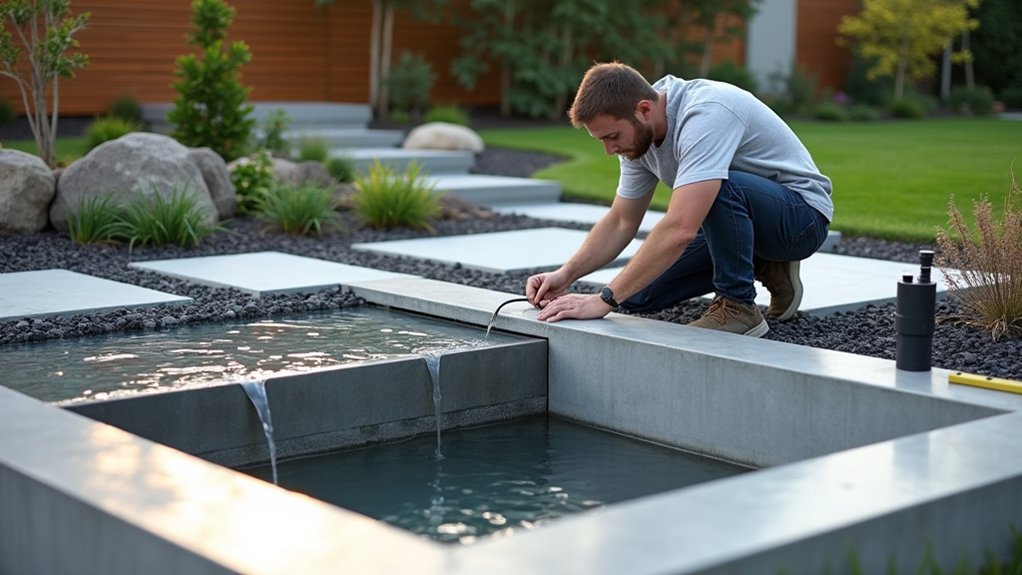
Before you buy materials or rent equipment, decide whether a modern fountain or a modern pond fits your space, budget, and maintenance tolerance.
A fountain is typically a closed-loop, pump-driven feature with predictable water volume, straightforward winterizing, and fewer biological variables. You’ll spend on a basin, pump, plumbing, and a GFCI circuit, but you can limit ongoing costs with efficient pumps and a simple mechanical filter.
A modern pond adds liner, edging, skimmer, and often biofiltration; it also introduces algae control and sediment management, increasing maintenance complexity. If you want fish or plants, plan for aeration and seasonal care.
Let your Aesthetic preferences drive form—minimalist spillway fountain versus reflective pond plane—then pick the system that matches your tolerance for interventions.
Check Space, Budget, and Upkeep First
Now that you’ve narrowed it to a modern fountain or a modern pond, pressure-test the plan against three constraints: the footprint you can dedicate, the all-in install cost, and the maintenance you’ll actually keep up with.
Measure usable square footage, include service clearance, and confirm you can route power and, if needed, a water line without major hardscaping.
Run budget considerations with a line-item list: basin/liner, pump, filter, plumbing, electrical, stone or concrete edging, and a GFCI circuit. Add 10–20% contingency for fittings and excavation.
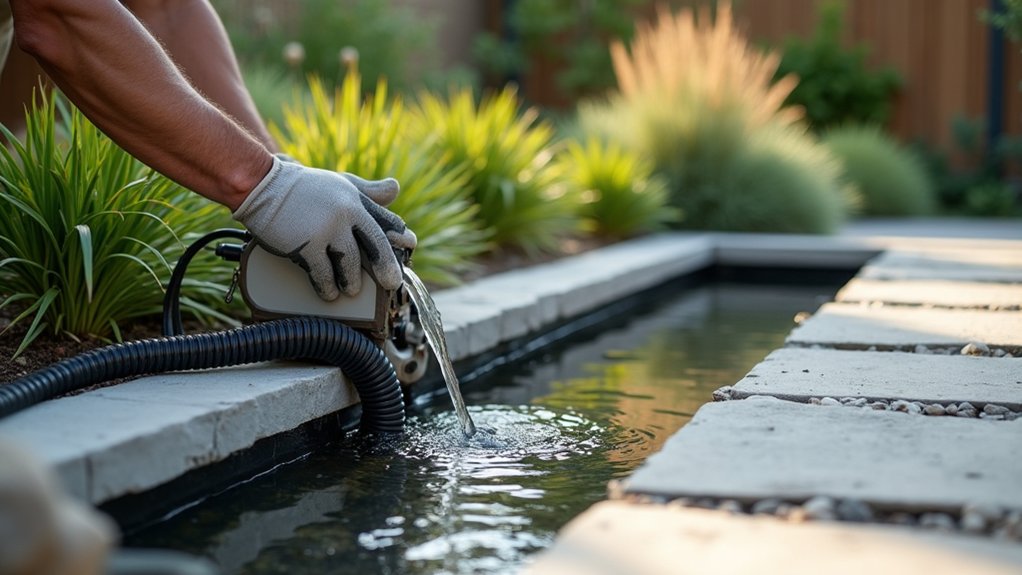
Lock in maintenance planning before you buy: weekly debris removal, monthly pump intake checks, seasonal drain-down or netting, and algae control. If you won’t do it, size up filtration or simplify the design.
Choose the Best Location (Sound, Sun, Views)
You’ll get better water clarity and lower algae-control costs if you balance sun and shade—aim for morning sun with afternoon protection where possible.
Place the fountain or pond where you’ll hear it from key seating areas and nearby windows, but keep it far enough from bedrooms and neighbors to avoid noise complaints.
Set the basin so you can see it from main sightlines and access it easily for power, topping up, and routine cleaning.
Optimize Sun And Shade
Although water features tolerate a range of conditions, you’ll get the best performance and lowest maintenance by placing the fountain or pond where sun and shade balance algae control, plant health, and your daily sightlines.
Aim for 4–6 hours of direct sun to support lilies and marginal plants without supercharging algae; in hotter zones, target morning sun and afternoon shade.
Use shade management with nearby shrubs, pergolas, or shade sails instead of large trees that drop leaves and spike skimmer and filter cleaning.
Keep the basin out of constant full shade if you want flowering plants, but avoid all-day sun if you’re trying to limit chemical treatments.
Check seasonal shadows, too; winter sun angles can shift your sunlight balance and water temperature materially.
Position For Sound And Views
Once you’ve balanced sun and shade for plant growth and algae control, set the feature where it earns its keep in daily use—both visually and acoustically. Aim sightlines from your kitchen window, patio seating, and main path so you’ll actually see the water feature without rearranging furniture. Keep it close enough to enjoy, but far enough that splash won’t hit siding or stain paving.
For garden acoustics, use hard surfaces to your advantage: place the fountain within 10–20 feet of a wall, fence, or hedge to reflect sound toward seating. Avoid open lawn centers where noise dissipates.
Position it to mask street traffic by aligning the source between you and the road. Test with a bucket-and-pump setup before you trench, so you won’t pay twice.
Plan Power, Water Supply, Drainage, and Safety
Where will the pump and lights draw power, and how will water get in and out without creating a hazard? Plan a dedicated, GFCI-protected circuit and weatherproof shutoff within reach. Run electric wiring in buried conduit to prevent cuts from tools; keep connections above grade in an IP-rated box.
Size wire for load and distance to avoid voltage drop, and add a timer to cut operating costs. For supply, use a hose bib with a backflow preventer or an auto-fill valve; include a simple prefilter.
Build water filtration around a skimmer and pump strainer so debris doesn’t jam impellers. Provide overflow to a drain line, dry well, or rain garden, sloped away from foundations.
Cover cables, add non-slip edging, and post-child safety barriers as needed.
Pick a Modern Style That Fits Your Yard
Pick a modern fountain or pond by sizing it to your yard’s footprint, sightlines, and setbacks so it doesn’t overpower the space or force costly rework. Keep the proportions tight: compact basins suit small patios, while longer, low profiles fit wide, open runs.
Then coordinate materials and finishes—concrete, stainless, stone, or composite—with existing hardscape and fixtures so you can reuse matching edging, caps, and hardware instead of custom orders.
Match Scale To Space
Even if you love the look of a big statement fountain, your yard’s footprint should set the size and layout. Start with scale considerations: measure usable patio or lawn area, then reserve clearances for walking, seating, and maintenance access.
Use space planning to keep the feature proportional—roughly 10–20% of the visible zone, not the whole yard.
Map utilities and drainage before you buy anything. A compact wall fountain or narrow rill suits tight lots because it needs less basin volume, less excavation, and smaller pumps.
In larger yards, you can step up to a wider pond, but keep edges simple to reduce liner waste and labor.
Plan sightlines from windows and paths so the feature reads intentional, not crowded.
Coordinate Materials And Finishes
Because modern water features rely on clean lines, the materials and finishes you choose will set the tone as much as the fountain’s shape. Start by matching hardscape: if your patio is poured concrete, pick brushed stainless, smooth concrete, or matte black powder-coated steel. If you have pavers, consider honed basalt or dark porcelain cladding.
Prioritize Material compatibility—avoid mixing reactive metals with chlorinated water, and separate dissimilar metals with nylon washers to reduce galvanic corrosion.
For Color coordination, sample finishes in the same lighting your yard gets, then repeat one dominant neutral and one accent across coping, edging, and nearby planters.
To control costs, use premium facing only on visible sides and specify sealed, non-slip surfaces for surrounding walk paths too.
Choose Durable Modern Materials and Finishes
While sleek lines set the look, your fountain or pond will only stay modern if the materials and finishes can handle constant water exposure, UV, freeze–thaw cycles, and routine cleaning without degrading.
Start with stainless steel (304 minimum; 316 near salt or deicers) for spillways, fasteners, and grates to prevent rust staining.
Use polished concrete for basins or caps, but specify a low-permeability mix, tight trowel finish, and penetrating sealer rated for immersion; that limits spalling and efflorescence.
For liners, choose 45-mil EPDM or reinforced PVC and protect it with geotextile underlayment.
Avoid painted mild steel and soft limestone; they pit, flake, or dissolve.
Match metals to reduce galvanic corrosion, and buy replaceable sacrificial anodes if needed.
Install and Maintain Clear, Algae-Free Water
If you manage nutrients, sunlight, and circulation from day one, you’ll keep a modern fountain or pond clear without expensive “miracle” additives.
Start with a properly sized pump that turns the full volume at least once per hour, and aim returns to eliminate dead zones.
Add a mechanical prefilter and a biofilter sized for your water volume; rinse media with pond water, not tap, to protect bacteria.
For Algae control, limit runoff by edging, keep mulch and soil out, and feed fish sparingly.
Shade 40–60% of the surface using plants, a sail, or a pergola.
Test weekly for ammonia, nitrite, and phosphate, then do 10–20% water changes as needed to restore Water clarity fast.
Frequently Asked Questions
Do I Need a Permit or HOA Approval for a Backyard Fountain or Pond?
You might need a permit and HOA approval, depending on local Legal requirements and property restrictions. Check zoning, electrical/plumbing codes, setbacks, and water-use rules. Review HOA covenants early to avoid fines and redesign costs.
Will a Fountain or Pond Attract Mosquitoes, and How Can I Prevent It?
Yes, it can, like a tiny buffet if you allow Water stagnation. Stop Mosquito breeding by running pumps daily, adding aeration, cleaning debris, using Bti dunks, and stocking minnows; they’re low-cost, effective.
How Do I Winterize My Fountain or Pond in Freezing Climates?
Drain lines, remove pumps, and store them indoors; you’ll prevent Freezing damage. Add Winter protection by covering basins, using a de-icer, and keeping water moving. Clean debris, check seals, and cut power.
Can I Add Fish or Aquatic Plants to a Modern Pond Design?
Yes—you can, like turning still water into a living engine. Choose Aquatic plant varieties suited to depth/light, confirm Fish compatibility with volume/filtration, add aeration, quarantine stock, and budget for feed and liners.
What Noise Levels Are Typical, and Can I Adjust the Sound?
You’ll typically hear 40–60 dB, depending on pump flow, drop height, and nozzle. You can adjust sound via Sound customization: valve down flow, swap nozzles, add baffles; use Noise reduction pads and quieter pumps.
About the Author