

If you’re weighing Bracknell, you’re really pricing in regeneration: what’s already delivered in the town centre versus what policy and funding will still push through. Phased development tends to front-load value uplift near stations, retail cores, and employment clusters, then flatten as supply catches up. But price growth isn’t automatic—you’ll need to track delivery risk, timing, and rental depth before you commit…
Key Takeaways
- Bracknell’s regenerated town core, streets, and station gateway have already improved liveability, supporting stronger buyer demand and resale comparables.
- Buying ahead of later phases can capture value uplift as delivery risk falls and new housing, connectivity, and employment upgrades complete.
- Target micro-locations near completed assets, Bracknell station, and key bus corridors, where accessibility and footfall translate into rent resilience.
- Track planning milestones, S106/CIL funding, and Local Plan allocations to time entry before uplifts and avoid over-supply price plateaus.
- Prioritise areas with policy-backed growth like Binfield-Warfield, while factoring school-capacity constraints, interest-rate volatility, and delivery delays.
What Is Bracknell Regeneration (Done vs Planned)?

Bracknell regeneration is the borough’s coordinated programme of public‑realm, housing, and commercial upgrades that’s already shifted the town centre’s economics, with further phases queued behind planning decisions and funding.
You can see what’s done: the redeveloped core, redesigned streets, new retail and leisure mix, and an upgraded station gateway that supports higher footfall and longer dwell time.
You’re also benefiting from policy alignment—Local Plan allocations, transport priorities, and town‑centre management—so delivery isn’t ad hoc.
What’s planned sits behind business cases and consents: additional housing sites, connectivity works, and employment‑space modernisation tied to net‑zero and design codes.
Track timelines through committee reports and S106/CIL receipts.
Use Historical context and Cultural influence to gauge how placemaking targets stable demand.
Will Bracknell Regeneration Raise House Prices?
With the town-centre core already rebuilt and further phases tied to consents, S106/CIL funding, and Local Plan allocations, the true question becomes how that delivery feeds through to pricing. You should expect uplift when phased completions reduce perceived delivery risk and when improved public realm tightens buyer comparables, but it won’t be linear.
Track Land Registry price-per-sq-ft, time-to-sell, and discount-to-asking against nearby baselines to isolate regeneration effects from wider Market trends.
Policy detail matters: if allocations increase net supply faster than absorption, prices can plateau even as quality improves.
Your Investment strategies should therefore target micro-locations closest to completed assets, favour homes with scarce parking/outdoor space, and time purchases ahead of milestone handovers rather than headline announcements.
Bracknell Regeneration Demand Drivers: Jobs and Amenities
As delivery shifts from planning headlines to operational assets, you’ll see demand in Bracknell concentrate around two levers: job density and amenity depth.
Regeneration programmes that bring forward Grade-A workspace, public-sector services, and mixed-use blocks tighten local labour markets and reduce vacancy risk, which feeds directly into rental resilience. You benefit most where employers cluster near retail cores and where planning conditions secure active ground floors, longer trading hours, and spend retention.
Amenity depth then converts employment into stay-put households. When policy ties developer contributions to schools, health provision, and Cultural hubs, you get higher weekday footfall and stronger evening economy signals.
Add maintained Green spaces and you lift liveability metrics, supporting longer tenancies, lower churn, and sharper buyer competition at resale.
Bracknell Transport Upgrades: How Commutable Is It?
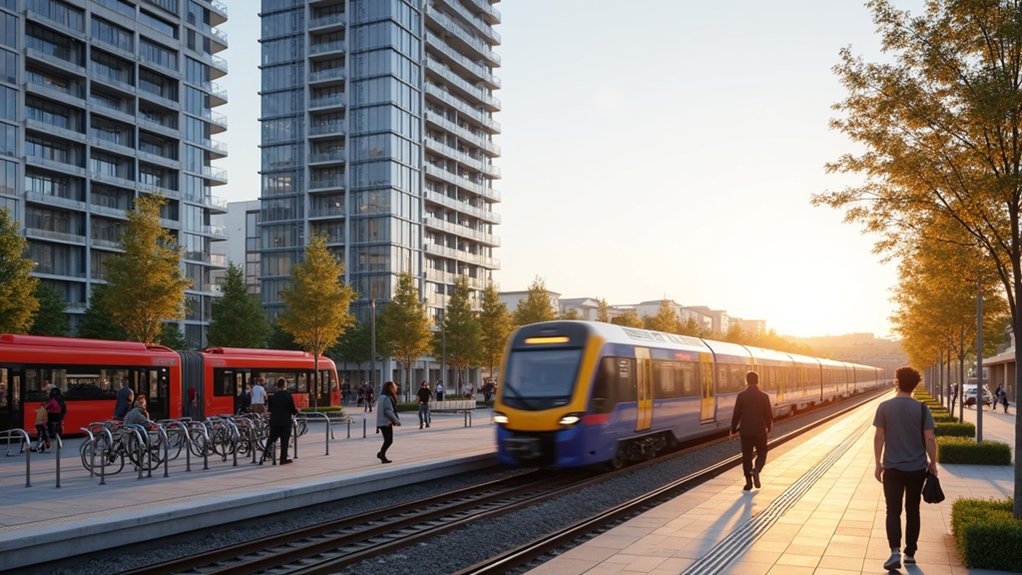
You’ll judge Bracknell’s commute appeal by how quickly rail gets you into London and how reliably it hits peak-hour frequency targets.
You’ll also weigh road access—M3/M4 connectivity, junction performance, and any capacity or safety upgrades—because it directly affects travel-time variance and logistics costs.
Finally, you’ll check whether local buses and onward connections integrate with rail timetables and key employment zones, since last‑mile reliability can make or break the market’s rental premium.
Rail Links To London
Bracknell’s rail links to London now anchor its commutability case, combining faster timetables with the wider policy push to shift growth to well-connected regional centres. You can reach London Waterloo via Woking in roughly 60–70 minutes, while services to Reading take about 15–20 minutes, giving you fast interchange to the Elizabeth line and Great Western.
That connectivity supports Sustainable infrastructure goals: more rail mode share, lower congestion, and higher station-area density without car dependence.
For buyers, you’re pricing into a commuter catchment that’s broadened by cross-London access and resilient demand from hybrid workers.
You’ll also see Community engagement reflected in station upgrades, step-free access, and cycle parking that councils and operators prioritise to meet inclusive-transport targets.
Road Access And Upgrades
While rail does the heavy lifting for peak-hour commuting, road access still shapes Bracknell’s day-to-day mobility and buyer demand: the town sits beside the A329(M) with fast links to the M4 (J10) and the M3 via the A322, putting Heathrow in roughly 25–35 minutes and central London in about 60–90 minutes depending on traffic.
You’ll also benefit from incremental corridor upgrades: managed motorways and junction improvements on the M4 reduce stop-start risk, while local developer-funded works have tightened roundabouts, signals, and pedestrian crossings around new housing.
That matters for valuations, because smoother peak dispersal supports higher rentability and widens the buyer pool. Better road permeability also makes it easier to reach Green spaces and Community events without parking stress or circuitous routes.
Local Buses And Connections
Road links help at the edges, but buses shape the “last mile” that determines whether a station-based commute actually works day to day. In Bracknell, you’ll judge value by frequency, span, and reliability, because those metrics protect your commute when rail runs hot.
Track Local bus routes that link estates to Bracknell station, The Lexicon, and key employment parks; tighter headways reduce the penalty of a missed train and widen your feasible catchment.
Policy-led investment in interchange design matters too: clearer bays, real-time screens, and integrated ticketing turn stops into Connection hubs rather than dead time. When buses connect cleanly, you’ll pay less for parking, keep travel times predictable, and see stronger rental demand from car-light households.
Bracknell Rental Demand: Who Rents Here Now?
Because the town’s jobs base and transport links have strengthened since the regeneration programme gathered pace, rental demand in Bracknell now comes from a broader, more segmented pool of tenants than a decade ago. You’ll see corporate renters tied to Thames Valley offices seeking turnkey Luxury apartments near rail, often on 12–24 month lets with employer-backed referencing.
You’ll also capture young families priced out of nearby markets, prioritising schools, parks, and longer tenancies that cut void risk. NHS and public-sector staff add stable, policy-insulated demand, particularly where commuting to Reading and London is viable.
Finally, a small but growing slice comes from Student housing linked to nearby colleges and training providers, supporting HMOs and studios. If you align spec, EPC, and affordability, you’ll keep occupancy high and arrears low.
Best Bracknell Areas to Buy for Regeneration Uplift
To target regeneration uplift in Bracknell, you’ll compare council-led investment and planning allocations by ward. Then, you’ll map them to recent price growth and transaction volume.
You’ll shortlist regeneration hotspots where policy commitments are funded and time-bound, because that’s where uplift tends to reprice fastest.
You’ll also flag transport-led value zones—walkable catchments to Bracknell station and key bus corridors—where accessibility upgrades can compress yields and push capital values higher.
Regeneration Hotspots By Ward
Where in Bracknell will regeneration translate into the cleanest price uplift over the next cycle? Start with Town Centre & Sandy Lane: public-realm spend around The Lexicon, active frontage policies, and higher footfall typically tighten yields fastest.
In Priestwood & Garth, you’re buying ahead of estate renewal, decarbonisation retrofits, and tenure-mix targets that can re-rate comparable sales once delivery milestones hit.
Binfield with Warfield suits you if you want policy-backed housing growth without overpaying for fully priced stock; watch phasing and school-capacity constraints.
Crowthorne offers a scarcer, higher-ticket angle where planning control preserves historical architecture and underpins premiums; add seasonal demand spikes from cultural festivals and events.
Track ward-level pipeline approvals, grant funding, and completion dates—not headlines.
Transport-Led Value Zones
If you anchor your buy-box to rail, bus priority, and junction upgrades, you can often capture uplift before the wider regeneration narrative gets priced in. Track walk-time to Bracknell station, planned bus-lane reliability, and M3/M4 access improvements; these compress commute risk and widen tenant demand.
Target corridors where policy stacks: town-centre intensification near the station for Luxury apartments, and edge-of-centre neighbourhoods that pair connectivity with Green spaces like parks and the Mill Pond.
You’ll often see faster rent reversion where new interchange public domain, cycle links, and parking strategy reduce car dependence. Compare EPC scores, service-charge budgets, and absorption rates on new-build phases; pricing gaps versus Reading and Wokingham can narrow as capacity upgrades complete.
Time your entry pre-completion, exit post-stabilisation.
Buy in Bracknell Now or Wait? Key Risks to Weigh
Although Bracknell’s regeneration pipeline and improved transport links keep demand resilient, deciding whether to buy now or wait comes down to how you price in near-term risks: interest-rate volatility, mortgage availability under tighter affordability rules, delivery risk on major schemes, and the chance that new supply tempers price growth.
If you need certainty, stress-test payments at higher SVRs and model remortgage shock; lenders’ affordability buffers can cap borrowing even if prices soften.
For Market timing, watch Bank of England guidance, swap-rate trends, and local planning consents that bring competing stock to market.
For Investment risks, audit developer track records, Section 106 dependencies, and phasing that could delay amenity uplift.
Buying now can lock today’s pricing; waiting may improve rates but risks tighter credit.
Frequently Asked Questions
What Are Current Council Tax Bands and Typical Annual Costs in Bracknell?
You’ll find Bracknell council tax bands A–H; typical annual bills run about £1,500 (A) up to £4,500+ (H). Your property valuation drives council tax assessment, so check the VOA band and council rates.
How Do Flood Risk and Drainage Issues Vary Across Bracknell Neighbourhoods?
Like a patchwork umbrella, you’ll see higher flood risk near the Cut and river corridors, lower on higher ground. You can check Environment Agency maps; councils prioritise Flood mitigation and drainage infrastructure upgrades for hotspots.
What Are Typical Service Charges and Ground Rents on Bracknell Leasehold Flats?
In Bracknell, you’ll typically pay £1,200–£2,500/year Leasehold fees via service charges; Service charge variations hinge on lifts, concierge, and sinking funds. Ground rents commonly run £0–£300/year, often capped on newer builds.
How Do Local Schools Perform, and Do Catchment Areas Affect Buying Decisions?
You’ll find school performance varies by Ofsted grade, progress scores, and attendance rates. You should track catchment zones, compare admissions policies, and verify distances, because strong schools tighten supply and lift prices for family buyers.
What Are the Common Planning Restrictions for Extensions, Lofts, and Conversions Here?
You’ll face building permit requirements for larger extensions, roof height changes, and flat conversions; permitted development covers smaller works. Watch heritage preservation constraints in conservation areas, plus parking, daylight, and neighbour-amenity policies impacting resale.
About the Author